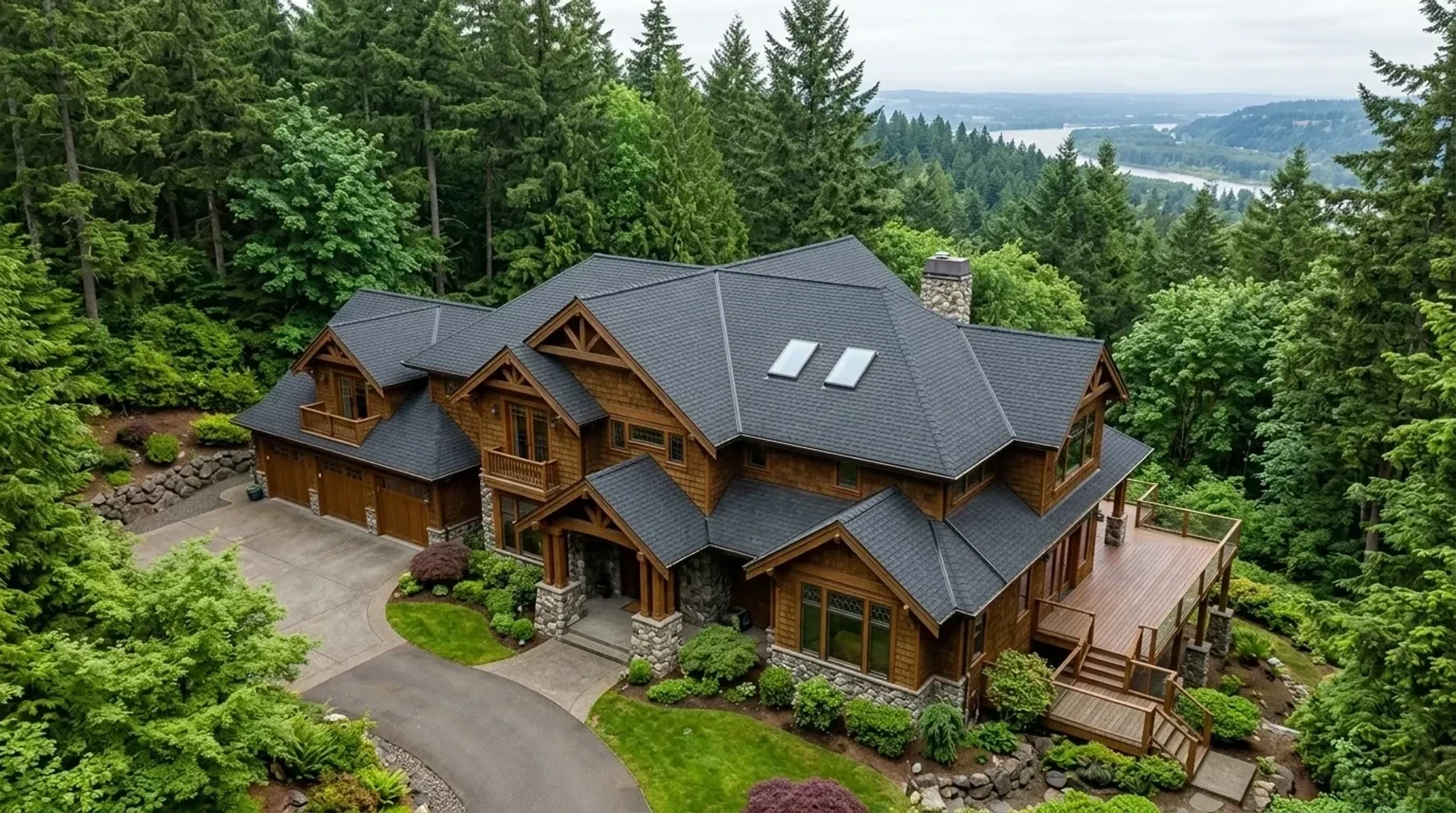
1. Roof Replacement Cost Guide: Indicative Vancouver WA Pricing
In Vancouver and Clark County WA, a full home tear-off and reroof costs between $15,000 and $28,000 for a typical 2,000 to 2,500 sq ft home ($7.50 to $9.50 per square foot for architectural shingles). Exact prices depend on pitch, decking rot, waste factor, and local building permit requirements.
The figures in this guide are illustrative planning ranges supplied for general comparison. They are not a live market survey, a published supplier price list, or a project quote. A site-specific price depends on measured roof area, pitch, access, tear-off layers, decking condition, material selection, permit requirements, and the written scope.
When comparing contractor bids, ask each roofer to show how the proposed total accounts for these items:
- Labor & Craftsmanship (42% to 48%): Safe structural tear-off, 6-nail high-wind mechanical fastening, flashing fabrication, and OSHA/WISHA compliant site safety.
- Materials & Components (32% to 38%): Architectural shingles, self-adhering ice and water membrane, synthetic base felt, drip edge, ridge caps, and pipe boots.
- Debris Hauling & Disposal (10% to 14%): Dumpster logistics and landfill tipping fees at Clark County transfer stations ($115 to $145 per ton).
- Permits, Coverage Plans & Project Overhead (6% to 10%): Municipal plan review, city inspections, maker enhanced Coverage Registration, and equipment insurance.
2. How Do Professional Roofers Calculate Roof Reroof Pricing?
Professional estimators calculate roofing cost using roof squares (100 sq ft units) multiplied by pitch slope factors (1.054 to 1.414), cutting waste factors (10% to 18%), and labor-plus-material rates per square.
Professional roofing roofers do not quote roofs based on simple ground-floor square footage. Roof geometry incorporates slope pitch and cutting waste. To calculate the true square footage of your roof, estimators apply a mathematical pitch factor and a waste factor:
Cost Estimation Advisory Desk
            Total Roof Area = (Ground Square Footage × Pitch factor) × (1 + Waste Factor Percentage)

            Total Project Cost = (Total Roof Area / 100) × Cost Per Installed Square
Roof Pitch factor Reference:
- Low Slope (4/12 Pitch): factor = 1.054 (gentle slope, easy foot traction).
- Standard Pitch (6/12 Pitch): factor = 1.118 (most common in Vancouver ranch and split-level homes).
- Moderate Steep (8/12 Pitch): factor = 1.202 (requires roof jacks and staging).
- Steep Pitch (10/12 Pitch): factor = 1.302 (requires full rope and harness fall-arrest systems).
- Severe Steep (12/12 Pitch): factor = 1.414 (45-degree angle, high labor intensity).
Cutting Waste Allowance: A standard gable roof with two simple planes requires a 10% waste factor (1.10). A complex roof with hip ridges, dormers, and valleys requires a 15% to 18% waste factor (1.15 to 1.18) to account for diagonal angle cuts and ridge overlaps.
Project Estimating Line
Case 1: Single-Story Ranch Home in Cascade Park (Vancouver, WA 98684)
Specs: 1,800 sq ft ground footprint, simple 4/12 pitch (1.054 factor), gable design (10% waste factor), single-layer tear-off.
- Calculation: 1,800 × 1.054 = 1,897 sq ft base × 1.10 waste = 2,087 actual roof sq ft (20.87 squares).
- Architectural Shingle Price ($8.25/sq ft): $17,217 total investment.
- Includes: Complete tear-off, 2 sheets CDX plywood repair, synthetic base felt, and continuous ridge vent.
Case 2: Two-Story Craftsman Home on Prune Hill (Camas, WA 98607)
Specs: 2,400 sq ft home (1,400 sq ft roof footprint), steep 8/12 pitch (1.202 factor), multiple dormers and valleys (15% waste factor).
- Calculation: 1,400 × 1.202 = 1,683 sq ft base × 1.15 waste = 1,935 actual roof sq ft (19.35 squares).
- Malarkey Legacy Class 4 Impact Shingles ($9.50/sq ft): $18,382 total investment.
- Includes: Steep-slope safety staging, ice and water shield in all valleys, and Scotchgard algae-resistant granules.
Case 3: Custom Modern Home in Ridgefield, WA (98642)
Specs: 3,200 sq ft footprint, 6/12 pitch (1.118 factor), 24-gauge standing seam metal roof (12% waste factor).
- Calculation: 3,200 × 1.118 = 3,577 sq ft base × 1.12 waste = 4,006 actual roof sq ft (40.06 squares).
- Standing Seam Metal Panels ($16.00/sq ft): $64,096 total investment.
- Includes: Concealed clip fasteners, Kynar 500 fade-resistant finish, snow retention guards, and 50-year maker coverage.
3. How Do Different Roofing Materials Compare on Cost and Durability?
Architectural laminate shingles provide the most cost-effective protection ($7.50 to $9.50/sq ft, 30-50 year life), SBS impact shingles offer enhanced wind resistance ($9.00 to $11.50/sq ft), and standing seam metal delivers maximum 50-75 year storm defense ($14.00 to $18.00/sq ft).
Choosing the optimal material for a Pacific Northwest home involves balancing initial capital expenditure against lifecycle longevity, wind rating, and resistance to moss growth. The matrix below compares the five most common roofing systems installed in Clark County:
| Roofing Material System | Cost per Sq Ft | Average 2,200 Sq Ft Job | Wind Rating | Lifespan | PNW Moisture Rating |
|---|---|---|---|---|---|
| Architectural laminate (Malarkey Highlander / GAF HDZ). | $7.50 - $9.50. | $16,500 - $20,900. | 110 - 130 MPH. | 30 - 50 Years. | Excellent (with Algae Barrier). |
| Class 4 Impact SBS Shingles (Malarkey Legacy). | $9.00 - $11.50. | $19,800 - $25,300. | 130 MPH. | 50 Years. | Superior (Polymer Modified). |
| 24-Gauge Standing Seam Metal. | $14.00 - $18.00. | $30,800 - $39,600. | 140+ MPH. | 50 - 75 Years. | Maximum (Zero Moss Adhesion). |
| Commercial 60-Mil TPO Membrane (Flat Roofs). | $8.50 - $11.00. | $18,700 - $24,200. | 120 MPH. | 25 - 35 Years. | Impervious (Heat-Welded Seams). |
| Hand-Split Cedar Shake (Treated). | $13.00 - $18.50. | $28,600 - $40,700. | 115 MPH. | 25 - 35 Years. | Moderate (Requires Annual Moss Care). |
| Composite / Synthetic Slate (DaVinci). | $16.00 - $22.00. | $35,200 - $48,400. | 110 MPH. | 50+ Years. | Impervious (Non-Porous Polymer). |
4. What Line Items Make Up a Complete Roof Reroof Quote?
A full roofing bid breaks down into old shingle tear-off and transfer fees (10% to 14%), plywood sheathing repair ($85 to $120 per sheet), synthetic base felt with code-required ice barrier, continuous ridge ventilation ($650 to $1,400), perimeter flashings, and municipal permit fees ($250 to $650).
A legitimate roofer bid should always feature transparent, unbundled line items. Below is an engineering breakdown of the individual components that comprise a complete reroof project in Vancouver, WA:
- Complete Tear-Off & Disposal: Removing the existing roofing down to the sheathing adds labor and disposal costs. The amount depends on roof size, access, number of existing layers, and current facility fees.
- Plywood Sheathing check & reroof ($85 to $120 per 4x8 sheet): When moisture penetrates old shingles, CDX plywood or OSB decking develops localized dry rot or delamination. Roofers inspect 100% of decking after tear-off and replace soft sheets with exterior-grade plywood fastened with 8d ring-shank nails.
- Synthetic base felt & Ice Barrier ($0.80 to $1.35 per sq ft): Washington State home Code (IRC Section R905.1.2) mandates ice and water shield self-adhering membranes along all eaves (extending 24 inches past interior wall lines), valleys, and sidewalls to prevent capillary action and ice dam intrusion.
- Attic Ventilation System Overhaul ($650 to $1,400 total): Preserving shingle coverage plans requires achieving a 1:150 net open airflow ratio (or 1:300 with balanced continuous intake and exhaust). Installing continuous ridge vents paired with cleared soffit vents lowers summer attic heat from 140°F to 105°F, preventing shingle granule blistering.
- Perimeter Flashing & Pipe Boot reroof ($450 to $950 total): Reusing old rusted flashings is the leading cause of premature roof leaks. Our reroof protocol replaces all drip edge metal, plumbing vent neoprene boots, step flashing along siding, and custom counter-flashing around brick chimneys.
- City of Vancouver & Clark County Permits ($250 to $650): The City of Vancouver Community Development Department requires building permits for all complete reroofs. Our team manages the entire permit filing, code review, and final check scheduling.
5. Is a Complete Tear-off Better Than a Shingle Reroof Overlay?
Yes. A complete tear-off is overwhelmingly superior because it allows 100% check of plywood sheathing, secures direct ice barrier adhesion, qualifies for full 130 MPH wind resistance ratings, and prevents structural framing overload.
Some property owners ask whether they can save money by nailing new shingles directly over existing shingles (a reroof overlay). While an overlay can reduce upfront costs by $1,800 to $3,200 by avoiding tear-off labor and dumpster fees, experienced roofers strongly discourage overlays in the Pacific Northwest for four critical structural reasons:
| Evaluation Metric | Complete Tear-Off (Recommended) | Reroof Overlay (Not Recommended) |
|---|---|---|
| Decking check. | 100% visible, rotten wood replaced. | Zero visibility, rotten wood concealed. |
| Ice & Water Barrier. | Adhered directly to clean wood deck. | Cannot adhere to old textured shingles. |
| Wind Rating. | Full 130 MPH maker coverage. | Voided or reduced to 60-70 MPH. |
| Structural Dead Load. | Normal weight (2.4 lbs/sq ft). | Dangerous double weight (5.0 lbs/sq ft). |
| Expected Service Life. | 30 to 50 Years. | 12 to 18 Years (curls from trapped heat). |
6. How Do Clark County Microclimates Affect Roofing System Longevity?
Vancouver and Orchards face severe tree moss and needle dampness, Camas and Washougal endure high-velocity 75+ MPH Columbia Gorge wind shears requiring 6-nail patterns, and Ridgefield and Battle Ground experience rural freeze-thaw cycles requiring heavy-duty ice barriers.
Clark County spans diverse microclimates that influence material selection and reroof frequency:
- East Vancouver & Orchards (98682, 98684): Densely developed suburban neighborhoods where mature Douglas fir trees deposit needle acid and shade that accelerates moss colonization. Algae-resistant shingles with Scotchgard copper granules are highly recommended.
- Camas & Washougal (98607, 98671): Positioned at the mouth of the Columbia River Gorge, these homes face sustained winter wind shears exceeding 60 to 75 MPH. Fastening shingles with an exacting 6-nail high-wind mechanical pattern is non-negotiable.
- Ridgefield & Battle Ground (98642, 98604): Characterized by larger acreage properties and newer home subdivisions. Roof replacements here frequently utilize standing seam metal roofing or polymer-modified Class 4 impact shingles to provide multi-decade fire and storm defense.
7. Who Authored and Technically Verified This Roof Pricing Guide?
This full pricing guide was written by our Master Roofing Specialist with 22 years of Clark County field experience, and verified by our Senior Estimator.
Vancouver Estimating Center
Senior Project Estimator | Clark County, WA
Our Technical Lead has directed more than 2,800 home tear-offs and commercial flat roof replacements across Clark County over 22 years of continuous field practice. Specialized in steep-slope ventilation physics, wind shear fastening engineering, and Pacific Northwest moisture remediation.
8. Frequently Asked Questions About Roof Reroof in Vancouver WA?
Below are expert contractor answers to the most common owner questions regarding reroofing expenses, winter installs, plywood repairs, and City of Vancouver permit guidelines.