
Wind & Storm Damage Roof Restoration in Vancouver WA
Fast, reliable storm damage roof restoration for properties impacted by high Columbia Gorge winds, fallen branches, and sudden torrential downpours. We secure active water leaks immediately, document all damage for your insurance adjuster, and complete permanent structural repairs using matching architectural shingles and reinforced flashing.
- Target Audience & Use Cases: Homeowners, commercial building managers, and rental property owners in Clark County dealing with active leaks, wind-creased shingles, or tree damage.
- Insurance Claim Support: GPS-tagged photo documentation, attic moisture readings, on-site adjuster walk-throughs, and zero out-of-pocket surprise fees.
- Benchmark Proof & Example: Following recent 70 MPH Gorge wind gusts in Washougal and Camas, our crews stabilized 19 properties within 90 minutes of dispatch, achieving 100% initial insurance claim approval.
What Types of Storm Damage Affect Vancouver WA Roofs Most?
Clark County experiences several types of storm events throughout the year. Understanding the specific type of damage your roof has sustained helps us deploy the right crew with the right materials for an efficient, thorough repair.
Wind Damage
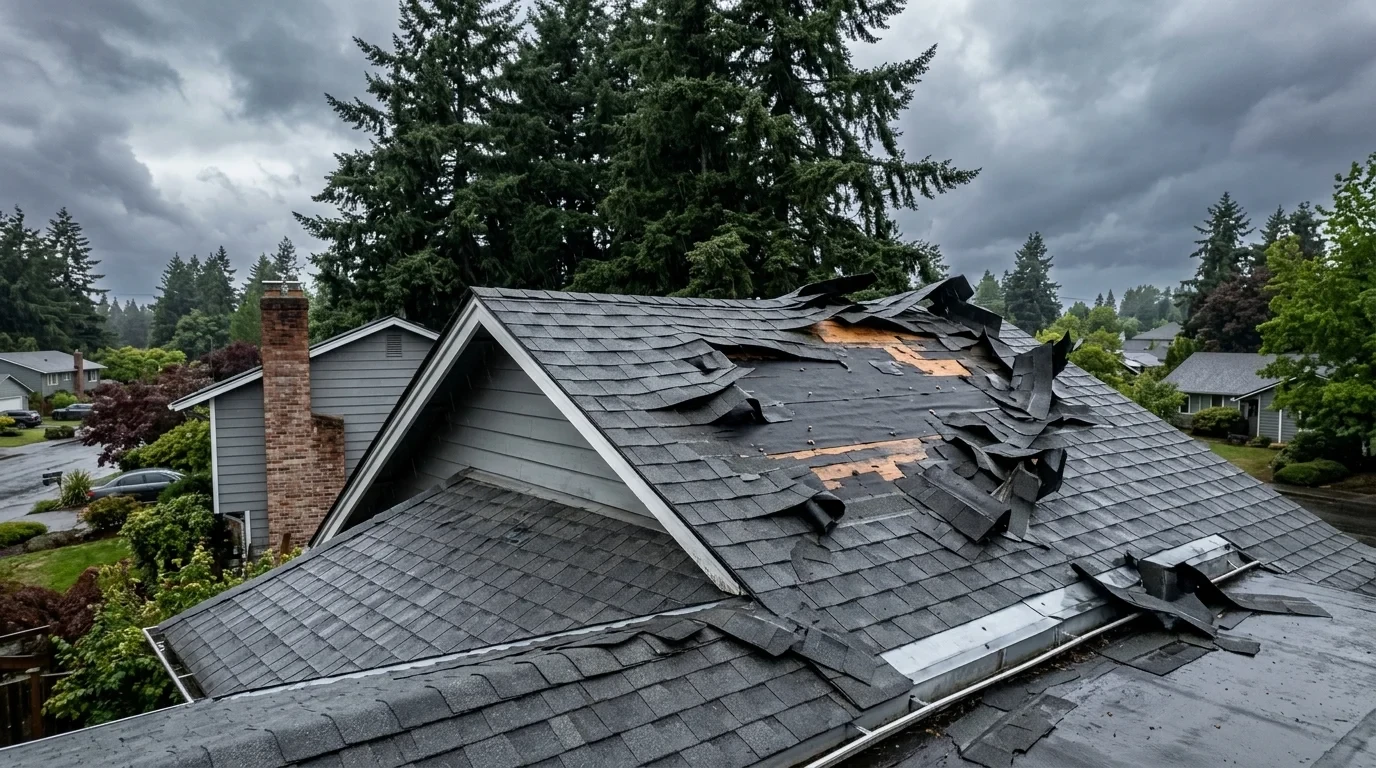
Vancouver, Washington and Clark County regularly experience wind events with gusts between 40 and 80 MPH, particularly during the fall and winter months when Pacific frontal systems push through the region. Washougal and eastern Clark County near the Columbia Gorge corridor experience even higher wind speeds. Wind damage to roofing typically manifests as lifted or missing shingle tabs, creased shingle surfaces where wind caught an edge and bent it, displaced ridge cap shingles along the highest roof line, and in severe cases, sections of decking plywood torn away from the roof structure.
What many homeowners do not realize is that wind damage is often invisible from ground level. A shingle tab can be lifted and its sealant strip broken without the tab actually flying off the roof. This compromised seal allows wind-driven rain to penetrate beneath the shingle surface during the next rain event, causing interior leaks that appear to come from nowhere. Our post-storm inspections catch these hidden failures before they cause water damage.
Fallen Tree and Branch Impact
With Clark County's heavy evergreen canopy of Douglas fir, western red cedar, and big-leaf maple, falling branches and whole trees are a primary cause of serious roof damage during storms. Even a branch as small as 4 inches in diameter can puncture through shingles, underlayment, and decking plywood when it falls from 40 to 60 feet above your roof line. Larger trees can collapse entire roof sections, creating structural emergencies that require immediate tarping and stabilization.
Our storm response crew arrives with tarping equipment and structural assessment capability to stabilize your property and prevent further water damage. We coordinate with tree removal services when necessary and document the entire scene for your insurance claim before any debris is removed, ensuring the adjuster has complete evidence of the damage extent.
Hail and Ice Damage
While Clark County does not experience hail as frequently as regions east of the Cascades, significant hailstorms do occur several times per decade and can cause widespread damage across neighborhoods. Hail impacts create circular dents in shingle surfaces that fracture the protective granule coating. These impact points accelerate UV degradation and become leak-prone areas within one to two years even though no immediate leak is apparent.
Ice damage occurs during occasional sub-freezing events when ice dams form along eave edges. Water backs up behind these ice ridges and seeps beneath shingles, causing damage to underlayment, decking, and interior ceiling surfaces. Homes without adequate ice and water shield membrane at the eaves are particularly vulnerable during these events.
Heavy Rain and Water Intrusion
Sustained heavy rainfall during Clark County's wet season can expose hidden vulnerabilities in aging roofing systems. While a single rain event may not cause problems, prolonged periods of heavy precipitation can overwhelm damaged flashing details, clogged gutters, and compromised sealant joints that were barely holding on. The result is active water intrusion through the roof surface into attic insulation, ceiling joists, and interior living spaces.
Our storm damage assessment includes checking all common water entry points: valleys where debris dams create backup, step flashing at roof-to-wall transitions, pipe boot gaskets that have cracked from UV exposure, and ridge cap shingles where wind has broken the adhesive seal. Each vulnerability is photographed and documented before repairs begin.
How Do You File a Successful Roof Insurance Claim After a Storm?
Direct Answer: To file a successful insurance claim, notify your carrier immediately after securing temporary tarping, compile date-stamped photographic evidence, and obtain an itemized Xactimate damage estimate from a licensed local contractor. We meet your insurance adjuster on-site during the walkthrough to ensure full roof scope inclusion.
Filing an insurance claim for storm damage can be overwhelming, especially when you are dealing with an active leak or structural compromise. Our team has worked with every major insurance carrier operating in Clark County and understands exactly what documentation adjusters need to approve your claim quickly and completely.
Unlike contractors who submit vague damage descriptions, we provide adjusters with timestamped photos tagged with GPS coordinates, measured damage area calculations, specific material and labor line items using Xactimate estimating software (the same tool insurance companies use internally), and written scope descriptions that match insurance terminology. This level of documentation significantly reduces claim disputes and speeds up approval timelines.
We also attend the adjuster's on-site inspection whenever possible. Having a qualified roofing professional present during the adjuster's visit ensures that all damage is identified, including hidden damage that may not be visible from ground level. Insurance adjusters appreciate working with professional contractors who communicate clearly and document thoroughly because it makes their job easier too.
Initial Damage Assessment
Our team arrives on site, conducts a thorough inspection of all roof surfaces, and documents every area of storm damage with timestamped, GPS-tagged photographs.
Emergency Stabilization
If active leaks or structural compromise exist, we perform immediate tarping and temporary repairs to prevent further water intrusion while the insurance process proceeds.
Claim Filing Assistance
We prepare a detailed damage report with photos, measurements, and material specifications. We help you file the claim with your insurance carrier and provide all supporting documentation.
Adjuster Meeting
We attend the on-site adjuster meeting to walk through every damage point and ensure nothing is missed or undervalued in the assessment.
Permanent Repair or Replacement
Once the claim is approved, we schedule and complete the permanent repairs using quality materials that restore your roof to pre-storm condition or better.
Storm Damage Severity & Action Matrix
Compare storm impact levels, immediate risk mitigation, and recommended repair pathways in Clark County.
| Storm Severity | Visible Symptoms | Immediate Mitigation | Permanent Solution |
|---|---|---|---|
| Moderate Wind (40-55 MPH) | Creased tabs, scattered granules in gutters, loose ridge caps | Roof inspection, resealing uplifted shingles | Targeted shingle replacement & 6-nail wind pattern reinforcement |
| Severe Wind (60-80 MPH) | Exposed plywood deck, missing shingle sections, torn flashing | Emergency UV tarping anchored with 2x4 lumber battens | Deck repair, synthetic underlayment, architectural reroofing |
| Tree Branch Impact | Punctured decking, broken rafters, interior water streaming | Limb clearance, 3/4 inch CDX plywood deck capping, tarping | Framing structural sistering, decking replacement, new shingle field |
| Hail Impact | Dented soft metal vents, fractured mineral granule coat | Test for micro-fissures and moisture penetration | Complete slope or full roof insurance replacement |
What Should Homeowners Do Immediately After a Roof Storm Event?
Stay Safe and Stay Off the Roof
Never climb onto a storm-damaged roof. Structural members may be compromised, surfaces are slippery from rain, and falling debris poses ongoing hazards. Assess damage from the ground or through attic access only.
Document Everything with Photos and Video
Before cleaning up any debris, take photos and video of all visible damage from multiple angles. Include wide shots showing the overall scene and close-up shots of specific damage areas. This documentation supports your insurance claim.
Call Your Insurance Company Promptly
Most homeowner policies require prompt notification of damage. Call your insurance carrier's claims line as soon as possible after the storm. Note the claim number, adjuster name, and any reference numbers for your records.
Call Apex Roofers for Emergency Assessment
Contact us at (360) 325-8254 for emergency tarping if water is entering your home, or to schedule a thorough damage assessment. We provide the professional documentation your insurance company needs.
Avoid Storm Chasers
After major storms, out-of-state contractors flood affected areas offering quick repairs. These storm chasers often use substandard materials, lack Washington State licensing, and disappear before warranty issues arise. Always verify your contractor's WA State contractor license, general liability insurance, and local references before signing anything.
Report Storm Damage Now
Call our 24/7 emergency line or submit the form for next-business-day assessment. Active leaks and structural damage receive same-day emergency dispatch.
24/7 Emergency
Office
12917 NE 71st St, Vancouver, WA 98682, USA
Hours
Open 24 Hours, Monday through Sunday
Clark County Service Areas
Rapid 60-Minute Emergency Dispatch & On-Site Estimates In: