
Which Roof Components Are Most Prone to Leaks in Vancouver WA?
Skylights, metal flashings, and seamless gutters represent the three most common moisture intrusion points on Pacific Northwest homes.
How Do You Stop a Skylight from Leaking in Heavy Rain?
Direct Answer: Stopping a leaking skylight requires removing the perimeter shingles, rebuilding the curb with a minimum 4-inch deck clearance, wrapping it in self-adhering ice and water shield, and installing engineered step flashing kits from manufacturers like Velux or Fakro to guarantee a watertight seal.
Skylights bring natural light into interior spaces, but they are among the most common leak sources on Pacific Northwest roofs. The problem is almost never the glass itself. It is the curb framing, step flashing integration, and sealant joints surrounding the skylight that fail over time as UV exposure degrades the rubber gaskets and thermal cycling stresses the metal-to-shingle connections.
We install and repair all major skylight brands including Velux, Fakro, and custom-fabricated units. For leak repairs on existing skylights, we remove the surrounding shingles, inspect the curb flashing and ice and water shield membrane beneath, replace any compromised components, and reinstall fresh step flashing with proper headlap sequencing. The result is a skylight that performs as a weathertight, integrated part of your roof system rather than a vulnerable penetration point.
For new skylight installations, we always frame a proper structural curb with minimum 4-inch height above the roof deck, wrap the entire curb with self-adhering ice and water shield membrane, and install Velux or Fakro pre-manufactured flashing kits engineered for the specific skylight model and roof pitch. This approach eliminates the site-fabricated flashings that cause the majority of skylight leak failures within the first 5 years.
Common Skylight Problems We Fix
- Condensation dripping from single-pane skylights (upgrade to insulated dual-pane)
- Cracked or yellowed acrylic dome skylights (replace with tempered low-E glass)
- Leaking at the head (uphill) flashing junction during heavy rain
- Failed sealant joints between the skylight frame and curb
- Ice dam formation around the skylight perimeter in winter
- Worn rubber gaskets allowing wind-driven moisture infiltration
Affordable Skylight Pricing
Best Time to Install Skylights
The most affordable time to install skylights is during a roof replacement. When the shingles are already removed, the curb framing and flashing integration costs less because the crew is already working at the underlayment level. Adding a skylight during a reroof typically saves $300 to $500 compared to a standalone installation.
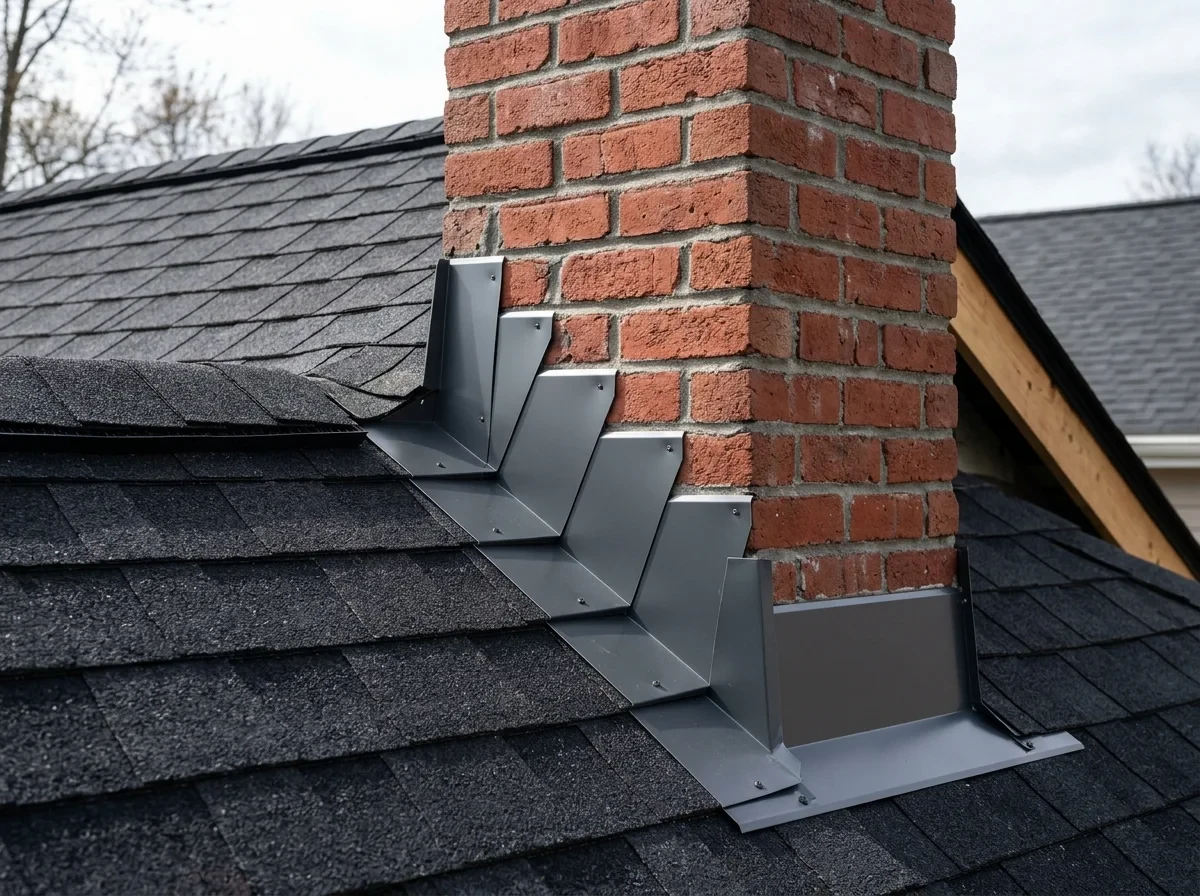
Flashing Types We Repair & Install
| Flashing Type | Location | Repair Cost |
|---|---|---|
| Step Flashing | Sidewalls, dormers | $250 - $800 |
| Counter Flashing | Chimney masonry | $350 - $1,500 |
| Pipe Boot/Jack | Plumbing vents | $150 - $400 |
| Valley Flashing | Roof valley intersections | $400 - $2,000 |
| Drip Edge | Eaves and rakes | $4 - $8/linear ft |
| Cricket/Saddle | Behind wide chimneys | $500 - $1,500 |
Clark County Flashing Fact
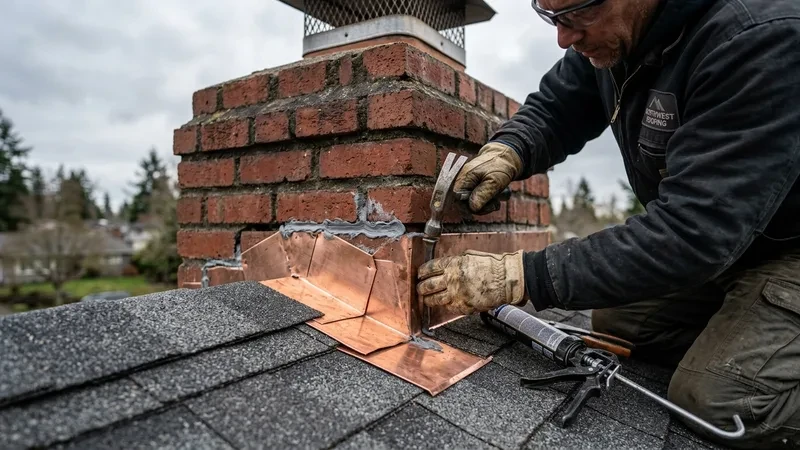
Chimney flashing failures account for approximately 35% of all roof leak service calls in Clark County. The combination of masonry expansion, metal contraction in cold weather, and 42 inches of annual rainfall creates a hostile environment for the caulk and mortar joints that seal counter flashings to brick and stone chimneys.
Why Does Chimney Flashing Fail and How Is It Repaired?
Direct Answer: Chimney flashing fails due to differential thermal expansion between masonry and wood framing, which cracks caulk and breaks mortar seals. Proper repair requires a two-piece flashing system: step flashing woven into shingle courses and counter flashing ground into masonry mortar joints with diversion crickets for chimneys wider than 30 inches.
Flashing is the metal barrier system that seals every transition point on your roof: where the roof meets a wall, wraps around a chimney, lines a valley, or surrounds a plumbing vent penetration. When flashing fails, water enters the building at these junctions. In Clark County's rain-intensive climate, even a hairline gap in a flashing seal can admit enough moisture over a single winter to cause significant structural wood rot and mold growth inside the wall cavity.
Our crews use 26-gauge galvanized steel and pre-painted aluminum flashing materials that resist corrosion in the Pacific Northwest's acidic rainfall (caused by evergreen needle tannins). For chimney flashings, we always install a two-piece system: step flashing interwoven with each shingle course, and counter flashing embedded into a mortar joint or reglet cut in the masonry. This two-piece design allows the roof and chimney to expand and contract independently without breaking the waterproof seal.
For chimneys wider than 30 inches, we fabricate and install a cricket (also called a saddle): a small peaked structure behind the chimney that diverts water and debris flow around the chimney rather than allowing it to pool against the uphill masonry face. Crickets are required by current Clark County building code for chimneys exceeding 30 inches in width, and we recommend them for any chimney where persistent debris accumulation is visible.
Pipe boot replacement is another common repair across Vancouver, Washington and our surrounding service area. The neoprene rubber collar surrounding plumbing vent pipes degrades after 12 to 15 years of UV exposure, cracking and allowing water to follow the pipe down into the attic space. We install high-quality EPDM rubber pipe boots with stainless steel clamp bands that maintain a tight seal for 25+ years.
According to official technical installation standards from the National Roofing Contractors Association (NRCA) Roofing Manual and the Sheet Metal and Air Conditioning Contractors' National Association (SMACNA) Architectural Sheet Metal Manual, metal roof flashings at masonry chimneys and sidewalls must incorporate two-piece counter-flashing systems to accommodate thermal movement.
When Should Seamless Gutters Replace Sectional Gutters?
Direct Answer: Sectional gutters should be replaced with seamless 5-inch K-style aluminum gutters when joint leaks occur or water overflows during moderate storms. Seamless gutters eliminate joint seams, use oversized 3x4 inch downspouts, and are fastened into rafter tails every 24 inches to withstand Pacific Northwest rainfall.
Gutters are the drainage system that protects your foundation, siding, and landscaping from the 42 inches of rainfall that Clark County receives annually. When gutters fail, the consequences extend far beyond the roof: uncontrolled water runoff erodes foundation soil, saturates basement walls, stains exterior siding, and creates pooling conditions that attract mosquitoes and promote mold growth at the building's base.
We install seamless 5-inch K-style aluminum gutters custom-fabricated on site from continuous coil stock. Seamless construction eliminates the joints that are the primary failure point in sectional gutter systems. Every installation includes oversized 3x4 inch rectangular downspouts (instead of standard 2x3 inch) to handle the high-volume rainfall events that are common during Clark County's October through March wet season when the Columbia Gorge wind funnels moisture-laden Pacific storms directly into our service area.
Our gutter hangers are spaced every 24 inches using heavy-duty hidden bracket fasteners screwed directly into the rafter tails, not the fascia board alone. This prevents the sagging and pull-away that plagues lightweight gutter installations within a few years of service, especially when ice and snow load the gutters in winter.
For homeowners tired of climbing ladders to clean clogged gutters, we install micro-mesh gutter guard systems that block leaves, evergreen needles, and roofing granules while allowing full water flow. Our preferred guard system features a surgical-grade stainless steel mesh bonded to an aluminum frame that installs under the first course of shingles for a clean, low-profile appearance.
Affordable Gutter Pricing
Signs Your Gutters Need Attention
- Water cascading over the gutter edge during moderate rain
- Visible sagging or separation from the fascia board
- Peeling paint or rust stains on the gutter exterior
- Foundation erosion or basement moisture below gutter runs
- Mildew or mold growth on siding near gutter sections
- Ice dams forming along the gutter line in winter