
Low-Slope & Flat Roof Replacement in Vancouver WA
Commercial and residential flat roofing solutions engineered for low-slope roofs facing persistent Pacific Northwest moisture and standing rainwater. We specialize in heat-welded TPO single-ply membranes, heavy-duty PVC systems, and torch-down modified bitumen, providing seamless watertight seals backed by dependable commercial warranties across Clark County.
- Target Audience & Applications: Commercial properties, retail centers, mid-century modern homes, garage conversions, and residential room additions across Clark County.
- Engineered Drainage: 1/4 inch per foot minimum slope design using polyiso tapered insulation to direct rainwater to commercial scuppers and drains.
- Real-World Proof: Over 150 low-slope roofs installed in Vancouver and Camas, featuring robotically tested 1.5-inch hot-air heat-welded seams with zero seam detachment.
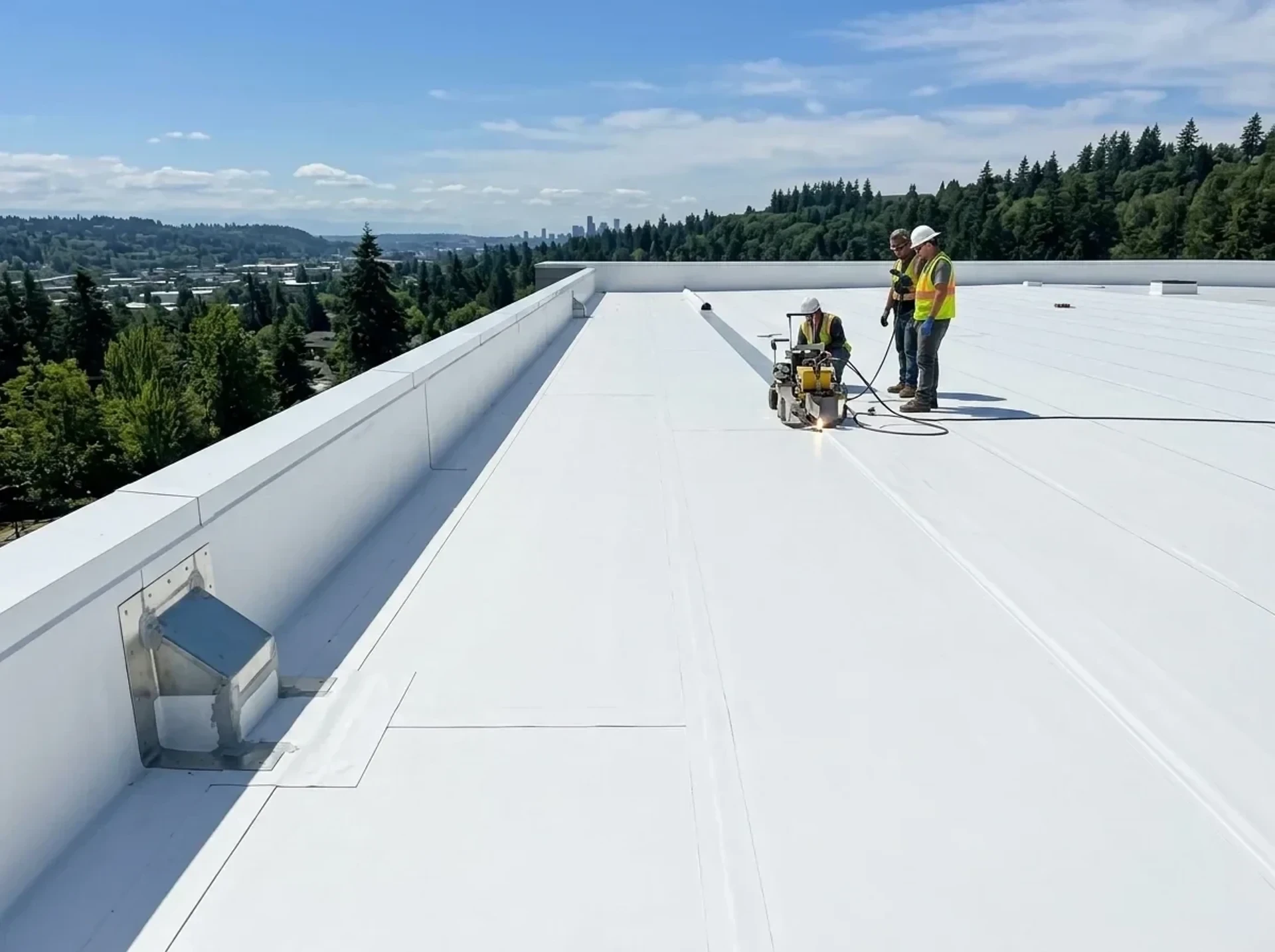
How Do Flat Roofs Handle Heavy Pacific Northwest Rain?
Direct Answer: Flat roofs manage Vancouver, Washington heavy rainfall through engineered positive drainage slopes (minimum 1/4 inch per foot) created by tapered polyisocyanurate insulation boards. Water is channeled into heavy-duty scuppers, interior drains, and oversized gutters, preventing standing water and ensuring heat-welded TPO or PVC seams remain 100% watertight.
The term "flat roof" is actually a misnomer. Every properly installed flat roof has a slight slope, typically 1/4 inch per foot minimum, to direct water toward drainage points. Without this engineered slope, water ponds on the membrane surface, accelerating material degradation and creating leak points at seams and penetrations. In Clark County, where annual rainfall averages 42 inches, proper drainage design is not optional. It is the single most important factor in flat roof longevity.
Our flat roofing projects always begin with a drainage analysis. We evaluate the existing deck structure, identify low spots where ponding occurs, and design a tapered insulation system that creates positive slope toward roof drains, scuppers, or gutter edges. This engineered drainage eliminates the standing water that destroys flat roofs prematurely. It is the difference between a flat roof that leaks within five years and one that performs reliably for two decades or more.
Flat roofs are found on a wide variety of Clark County properties. Residential applications include mid-century modern homes, room additions with low clearance constraints, covered patios, garage conversions, and sunroom enclosures. Commercial applications span retail strip centers, office buildings, restaurants, warehouses, and mixed-use developments. Each application has unique requirements for insulation value, foot traffic durability, and chemical exposure resistance that influence our material recommendation.
The good news for Clark County property owners is that flat roofing technology has advanced dramatically in the past two decades. Modern single-ply membranes with heat-welded seams create watertight surfaces that outperform older built-up and tar-and-gravel systems by a significant margin. These materials are more affordable to install, easier to maintain, and carry longer manufacturer warranty coverage than anything available 20 years ago.
According to official technical documentation and energy standards from the ENERGY STAR Roof Products Technical Specification and Washington State Department of Labor & Industries (WA L&I) commercial roofing codes, reflective low-slope single-ply membranes must maintain positive drainage slope to ensure long-term manufacturer warranty enforcement.
Our 3-Step Low-Slope Drainage & Installation Protocol
- Precision Slope Laser Measurement: We map low deck points and calculate required polyiso taper rates (minimum 1/4 inch per foot) to prevent water ponding.
- High-Density Cover Board & Membrane Laydown: A rigid gypsum cover board is mechanically fastened before rolling out commercial-grade 60-mil membrane sheets.
- Robotic Hot-Air Molecular Fusion: Seams are joined using automated hot-air welding equipment calibrated to ambient temperature and humidity for permanent bonds.
Affordable Flat Roof Pricing
Clark County installed pricing, including membrane, insulation, flashings, and labor
Get Your Affordable Flat Roof Quote
Free on-site evaluation with written bid. No obligation.
Request Free BidWhich Flat Roofing System Is Best for Clark County Properties?
Choosing the right flat roof membrane depends on your building's use, budget, and specific exposure conditions. Here is a detailed comparison of the four primary flat roofing systems we install, with honest guidance on which is best for your situation.
Flat Roof Membrane Systems Technical Comparison
Side-by-side technical evaluation of TPO, PVC, EPDM, and Modified Bitumen for Clark County properties.
| Membrane System | Seam Joining Method | Expected Lifespan | Installed Cost / Sq Ft | Optimal Use Case |
|---|---|---|---|---|
| TPO (Thermoplastic Polyolefin) | Robotic Hot-Air Heat Welded | 20 - 30 Years | $8.50 - $11.00 | Commercial buildings, modern homes, energy-efficient roofs |
| PVC (Polyvinyl Chloride) | Hot-Air Molecular Fusion | 25 - 30+ Years | $9.00 - $12.00 | Restaurants, kitchens, industrial facilities with chemical exhaust |
| EPDM Rubber | Adhesive Primer & Seam Tape | 15 - 25 Years | $6.50 - $9.00 | Budget installations, covered carports, low-traffic areas |
| Modified Bitumen | Multi-Layer Torch / Self-Adhered | 15 - 20 Years | $7.00 - $10.00 | High foot traffic decks, balconies, traditional multi-ply roofs |
What Are the Most Common Flat Roof Problems in Clark County?
Flat roofs face different challenges than sloped roofs. Understanding these common failure points helps you catch problems early before they require expensive repairs or premature replacement.
Ponding Water
Standing water that remains 48 hours after rainfall indicates inadequate drainage slope. Ponding accelerates membrane deterioration, adds structural weight stress, and creates concentrated leak risk at seam edges. Tapered insulation retrofit can correct ponding issues on existing flat roofs without full replacement.
Membrane Punctures
Foot traffic from HVAC technicians, dropped tools, and dragged equipment puncture through single-ply membranes. Designated walkway pads should be installed along all service access routes to protect the membrane surface. Our maintenance programs include puncture inspection at every visit.
Flashing Failures
Parapet walls, HVAC curbs, and rooftop penetrations are the most common leak points on flat roofs. Counter-flashing that separates from the wall surface, deteriorated sealant joints, and improperly detailed curbs all create direct water entry paths. These details require roofing-specific expertise that general contractors often lack.
Clark County Flat Roof Maintenance Checklist
- Drain Clearances: Inspect internal roof drains and scuppers for pine needle blockages after every storm.
- Seam Integrity: Examine membrane laps and heat-welded seams for thermal fatigue or edge lift.
- Walkway Protection: Verify rubber slip pads remain positioned along all HVAC service pathways.
- Flashing Seals: Check parapet wall counter-flashing and termination bar sealants for cracking.
Flat Roofing Questions from Clark County Property Owners
Request Your Affordable Flat Roof Assessment
Our project manager will inspect your flat roof, evaluate drainage conditions, and provide a detailed written bid with material options at different price points so you can choose the solution that fits your budget.
Phone
Office
12917 NE 71st St, Vancouver, WA 98682, USA
Hours
Open 24 Hours, Monday through Sunday
Clark County Service Areas
Rapid 60-Minute Emergency Dispatch & On-Site Estimates In: