
Commercial Flat Roofs: Heat-Welded TPO Roofing in Vancouver WA
We install energy-efficient 60-mil TPO single-ply roofs across Clark County. This durable system suits commercial flat and low-slope buildings. Hot-air welded seams form a tight waterproof barrier. It resists ponding water, reflects heat, and lowers cooling costs.
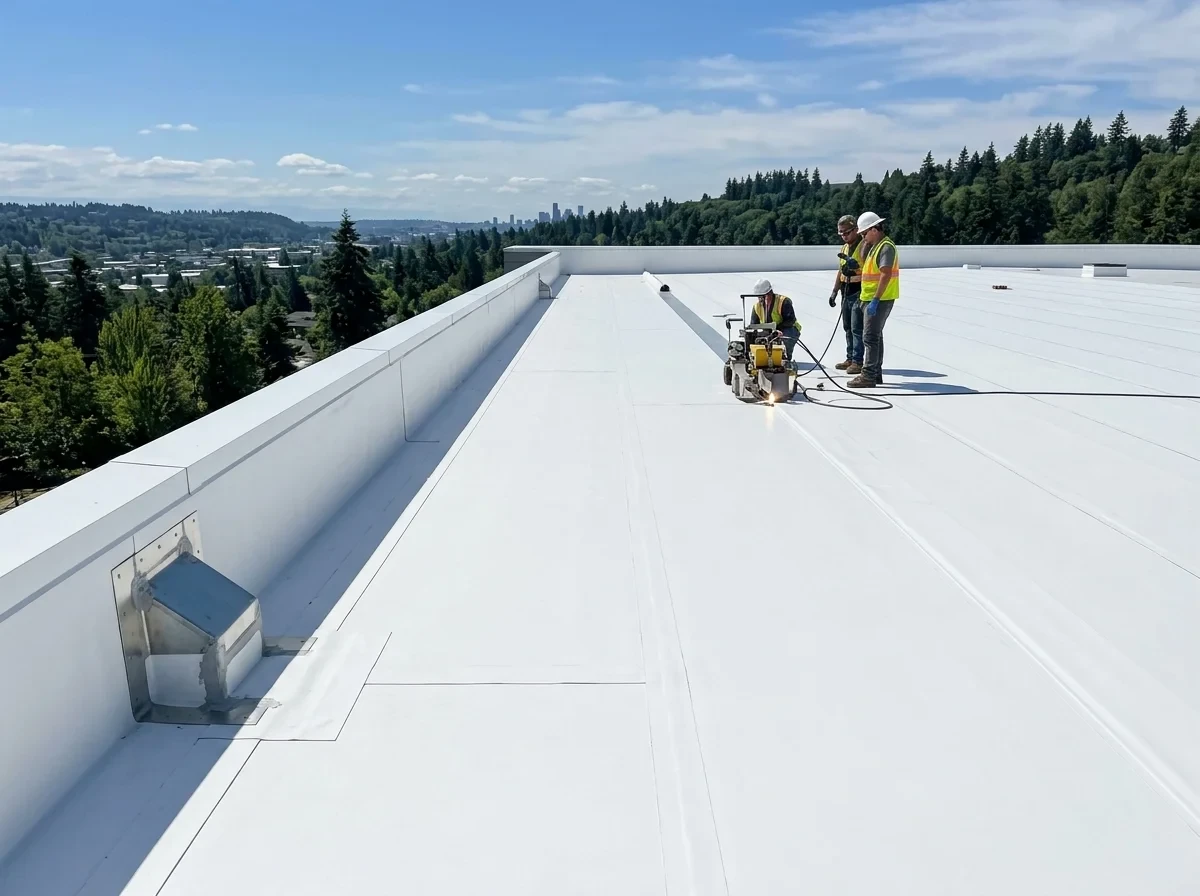
- Robotic Hot-Air Welded Seams: Robotic heat welding at 1,000 degrees Fahrenheit fuses seams. These bonds test up to four times stronger than adhesive tapes.
- ENERGY STAR reflection: High solar reflectance index (SRI > 100) deflects UV rays. This lowers cooling loads significantly.
- Ponding Water Resistance: Heat-welded monolithic seams easily withstand standing water zones common on low-slope Pacific Northwest roofs.
What Is Commercial TPO Roofing and How Does It Work in Vancouver WA?
Our roofing specialists install 60-mil commercial TPO single-ply roofing across Clark County. We use robotic hot-air seam welding for dependable ponding water resistance. Depending on project specifications and manufacturer requirements, commercial systems may be eligible for manufacturer No Dollar Limit (NDL) coverage options.
Source and Standards: All projects follow registered Washington contractor regulations and Single Ply Roofing Industry (SPRI) standards and Cool Roof Rating Council guidelines.
A commercial TPO install is a multi-layer engineered system, not a single sheet of plastic. Each component works together to create watertight, energy-efficient protection for your building.
Structural Deck Preparation
Crews remove old membranes or prepare the metal, concrete, or wood deck. We install tapered polyiso insulation boards to correct drainage slopes and eliminate ponding water zones.
Rigid Insulation Board
Rigid polyisocyanurate (polyiso) boards attach mechanically or with low-rise adhesive. Continuous insulation layers meet Washington State Commercial Energy Code (WAC 51-11C) R-30 minimum requirements on conditioned low-slope roof replacements.
Cover Board
High-density cover board creates a sturdy base. It shields insulation from foot traffic and tools during HVAC maintenance.
60-Mil TPO Membrane
Crews roll out white reflective membrane in wide rolls. Automated robotic welders fuse overlapping sheets with a 1.5-inch continuous weld at over 1,000 degrees Fahrenheit. Every seam is tested with a cotter probe to verify monolithic bond integrity.
Detail Flashing and Terminations
Custom-fabricated TPO boots seal around every pipe, curb, and HVAC penetration. Perimeter edge metal with membrane-welded termination bars creates a seamless transition at walls, parapets, and drip edges following verified low-slope flat roof drainage protocols.
How Do TPO Advantages Compare to Other Commercial Flat Roof Systems?
TPO outperforms older membranes through robotic hot-air seam fusion. These welds are stronger than the sheet itself. In addition, an 80% solar reflectance index (SRI) lowers rooftop cooling loads.
Technical Standards: Installation practices reference National Roofing Contractors Association (NRCA) guidelines and published single-ply manufacturer application specifications.
TPO is now the preferred commercial roofing choice across Vancouver WA. Heat-welded seams and reflective surfaces make TPO cost-effective and dependable.
Energy Star Reflective Surface
White TPO reflects up to 80% of solar radiation. This lowers rooftop temperatures by 50 to 60 degrees compared to dark membranes. Buildings save on cooling costs and may qualify for Clark County utility rebates.
Heat-Welded Seam Integrity
Robotic welders fuse overlapping sheets at a molecular level. These seams are stronger than the membrane itself. Glued EPDM seams degrade over time, but TPO welded seams do not.
Chemical and Grease Resistance
Exhaust fans release oils that dissolve standard rubber. TPO resists grease, animal fats, and rooftop chemicals effectively.
Manufacturer NDL Coverage Options
Some commercial TPO roofing systems may be eligible for manufacturer No Dollar Limit (NDL) coverage, subject to the manufacturer's requirements, approved installation details, and applicable contract terms.
Explore Related Clark County Commercial Roofing Services:
Explore our guide to chemical-resistant PVC membrane installs. You can review black synthetic EPDM systems, inspect silicone roof coatings, or access low-slope flat roof maintenance from our Vancouver commercial roofing division.
TPO System Pricing
Includes membrane, insulation, cover board, all flashings, and maker Coverage Registration. Pricing scales favorably on larger footprints.
Request TPO BidTPO vs. EPDM Rubber Membrane Comparison
| Performance Factor | TPO Single-Ply | EPDM Rubber |
|---|---|---|
| Seam Method. | Robotic Hot-Air Welded. | Adhesive Tape / Glued. |
| Solar Reflectance (SRI). | 80% (Energy Star). | 6% (Absorbs Heat). |
| Chemical & Grease Resistance. | Superior plastic. | Degrades (Use PVC for Fats). |
| Ponding Water Tolerance. | Monolithic Welded Bond. | Moderate Seam Stress. |
| Manufacturer Coverage Potential. | Eligible Manufacturer NDL. | Standard Membrane Terms. |
How Can Commercial Property Owners Request a Single-Ply Membrane Bid in Vancouver WA?
Contact our estimating team at (360) 325-8254. You can also submit building specs online for an on-site moisture scan and written proposal.
Our project manager conducts a thorough roof assessment. We review insulation thickness and deliver a clear project bid with project timelines.
Commercial Division
Apex Roofers Vancouver WA
Project Estimating Line
Local Address
12917 NE 71st St, Vancouver, WA 98682, USA
Commercial Response
Open 24 Hours, Monday through Sunday
Frequently Asked Questions About Single-Ply Heat-Welded Membranes?
Review key facts on install costs, 20 to 30-year lifespan benchmarks, heat-welding performance, and cool-roof savings in Clark County.