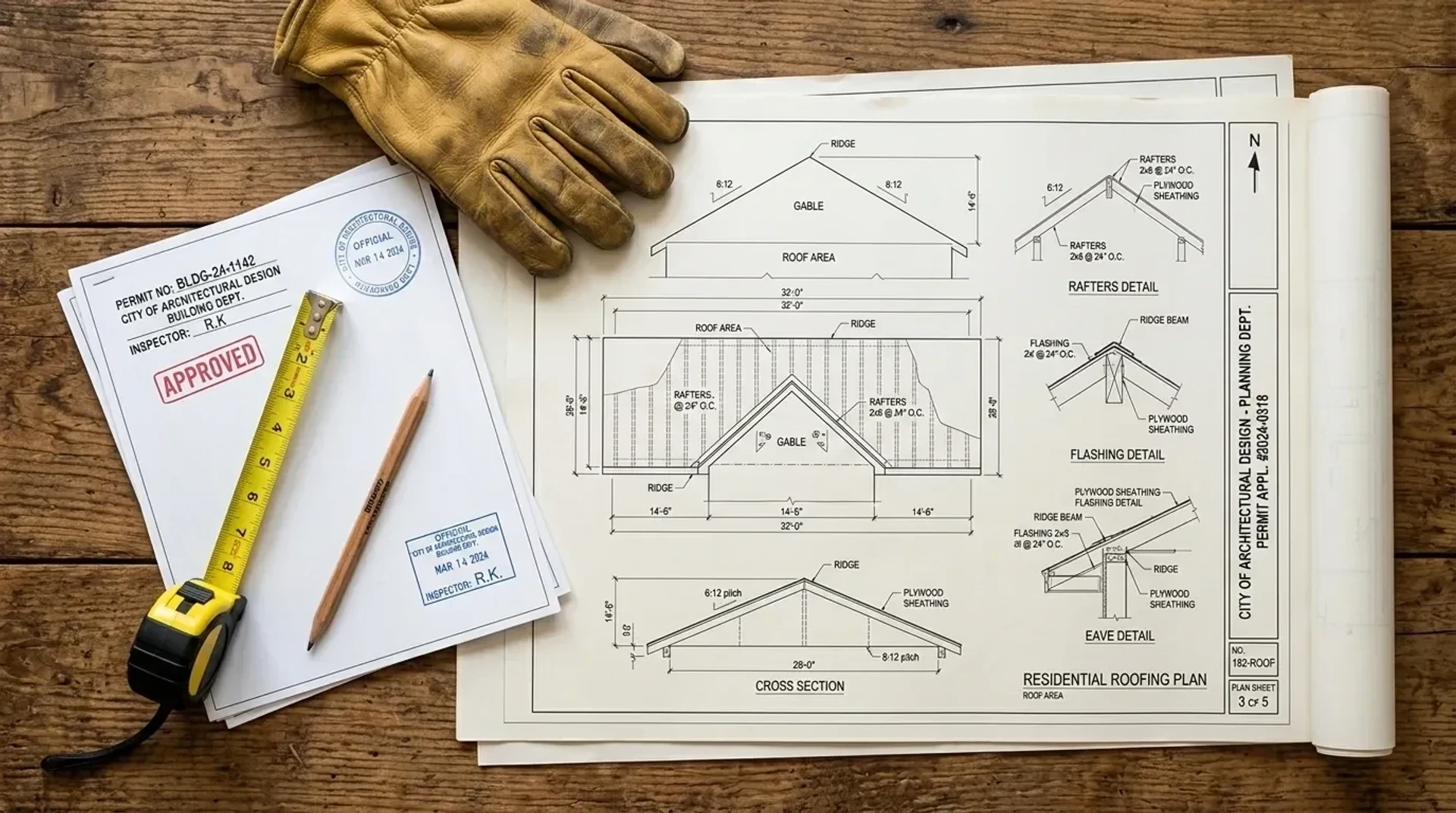
1. Vancouver Building Code Update: Permit Rules for Reroofing
City of Vancouver rules require building permits for all full home tear-offs and reroofs. Permit fees range from $250 to $650 based on project cost.
In the City of Vancouver, Washington, residential building codes fall under the area of the City of Vancouver Community Development Department. Under Vancouver city Code (VMC Title 17) and the Washington State Building Code Council, a formal building permit is required whenever a homeowner or contractor performs a complete residential tear-off and reroof.
A valid roofer holds an active WA L&I license, a $12,000 state bond, and $1,000,000 in liability insurance. Unlicensed crews skip permits to hide poor work, which hurts homeowners.
2. What Are the Ice and Water Shield Mandates under IRC Section R905.1.2?
Code requires self-stick ice shield from eave edges to 24 inches past the inner wall. Valleys need 36 inches of cover, and low-slope planes need double layers.
Under Clark County building standards enforced by the Clark County Community Development Department and IRC Section R905.1.2, because Vancouver experiences severe winter freeze-thaw cycles, building code enforces strict secondary waterproofing barrier requirements:
- Eave Protection: Self-adhering polymer-modified bitumen membrane (ice and water shield) must extend from the lowest roof edge to a point at least 24 inches inside the interior exterior wall line.
- Valleys and Sidewalls: All open and closed roof valleys must be lined with a minimum 36-inch wide ice and water membrane before valley flashing and roof transition detailing.
- Low-Slope Mandate (2:12 to 4:12 Pitch): Low-pitch roofs require either two full overlapping layers of synthetic base felt or 100% full-deck self-adhering membrane coverage.
3. How Does the 1:150 vs. 1:300 Attic Airflow Code Requirement Work?
IRC Section R806 requires 1 square foot of net unobstructed airflow area per 150 square feet of attic floor space, but allows a 1:300 ratio when balanced 50% between continuous low eave soffit intake vents and upper continuous ridge exhaust vents.
Inadequate attic airflow destroys asphalt shingles from underneath. Summer attic heat can reach 150°F, baking shingles. In winter, trapped moisture feeds wood mold. Homeowners can request a 21-point roof and attic inspection to evaluate existing airflow before work begins. Under current IRC Section R806, airflow must meet exact mathematical proportions:
Building Code Advisory Desk
            Total Required Attic Vent Area = Attic Floor Square Footage / 150

            Balanced Ratio = 50% Continuous Soffit Intake + 50% Ridge Cap Exhaust
When balanced between ridge vents and soffits, codes allow the 1:300 ratio. We install baffled ridge vents that block rain even in 70 MPH Gorge winds.
4. How Much Do Roofing Building Permits Cost Across Clark County Municipalities?
Permit fees run $285 to $480 in Vancouver, $245 to $420 in Clark County, $310 to $520 in Camas, and $260 to $440 in Ridgefield. All need final checks.
| area | Permit Fee Range | Required Inspections | Contractor Registration |
|---|---|---|---|
| City of Vancouver (98660 - 98684). | $285 - $480. | Sheathing / Mid-roof & Final. | WA State Registration + City Endorsement. |
| Clark County Unincorporated (Orchards, Hazel Dell). | $245 - $420. | Final Inspection Verification. | State Registration & Insurance Requirements. |
| City of Camas (98607). | $310 - $520. | Decking & High-Wind Pattern Final. | Camas Business Endorsement. |
| City of Ridgefield (98642). | $260 - $440. | Final Exterior Review. | Ridgefield city Registration. |
5. What Attic Insulation R-Values Are Required by Washington State Energy Code?
Under Washington State Energy Code (WSEC-R Climate Zone 4C), unconditioned attics require minimum R-49 insulation with rigid cardboard or plastic baffle vents at every rafter bay and expanding foam air sealing at all ceiling penetrations.
If a reroof changes ceiling framing or wood sheathing, it falls under the Washington State Energy Code. In Climate Zone 4C, insulation must block winter heat loss:
- Attic Insulation R-Value: Unconditioned attics must achieve minimum R-49 insulation (about 14 to 16 inches of blown-in fiberglass or 13 inches of cellulose), with an recommended target of R-60 on new roof framing.
- Baffle Vents at Eaves: To prevent insulation from blocking airflow from exterior soffits to the ridge vent, code mandates rigid cardboard or plastic insulation baffles (AccuVent or Durovent) installed above every rafter bay.
- Air Sealing Attic Penetrations: Expanding foam sealant must be applied around plumbing stack pipes, electrical wire penetrations, and recessed lighting cans to prevent warm, humid household air from rising into the cold attic space and condensing on roof sheathing.
6. Which Fasteners Are Approved under Vancouver Residential Roofing Code?
Vancouver building codes ban wire staples on shingles. Codes require galvanized roofing nails that penetrate wood sheathing firmly.
Vancouver building codes ban wire staples on shingles. Codes require galvanized roofing nails that penetrate wood sheathing firmly:
- Fastener Type: Minimum 11-gauge or 12-gauge hot-dipped galvanized roofing nails with a head diameter of not less than 3/8 inch (9.5 mm).
- Penetration Depth: Nails must penetrate at least 3/4 inch into the roof sheathing, or fully through the underside of 7/16-inch OSB or 1/2-inch CDX plywood sheathing.
- Ring-Shank Holding Power: Our roofing crews utilize electro-galvanized ring-shank nails that provide up to 40% greater pull-out resistance compared to smooth-shank nails, ensuring shingles do not tear away during winter high-wind shear events.
7. What Municipal Codes and Permits Does the City of Vancouver Require?
The City of Vancouver requires mandatory building permits for all complete roof replacements, code-mandated ice and water barrier along eaves under IRC standards, and verified WA L&I licensed contractors like our team at (360) 325-8254.
Code Compliance Advisory
The City of Vancouver legally mandates a building permit for any complete roof tear-off and replacement. Hiring unlicensed contractors or skipping permits can result in stop-work orders, municipal fines, and disclosure liabilities during future home sales.
- Complete Compliance Assurance: Our dedicated team handles all city permit filings and ensures your roof passes every official inspection.
- Mandatory Weather Barrier: We install self-adhering waterproof ice and water membranes at eaves and valleys adhering to current residential IRC standards.
- Direct Contractor Support: Contact our Vancouver office at (360) 325-8254 for comprehensive project evaluations and certified code coordination.
8. Who Authored and Technically Verified This Code Compliance Guide?
This regulatory analysis was prepared by our Vancouver Lead Building Code Inspector (WA General Contractor license holder with over two decades navigating Clark County structural codes), reviewed alongside our Senior Project Engineer.
Permit Advisory Center
Municipal Permitting Advisor | Clark County Code Specialist.
Our field engineering team maintains active certifications in Washington residential building codes, supervising compliant reroof installations across Vancouver neighborhoods.
9. Frequently Asked Questions About Vancouver WA Roofing Building Codes?
Below are expert contractor answers regarding City of Vancouver permit submissions, required inspections, attic airflow ratios, and layover restrictions in Clark County.