1. Columbia Gorge Storm News: Meteorology and Gorge Wind Shear
In winter, cold air over Eastern Washington rushes west through the Gorge gap. Winds blow at 50 to 65 MPH with gusts over 85 MPH in Washougal, Camas, and East Vancouver.
The Columbia River Gorge acts as a natural wind chute. Cold air in Eastern Washington rushes toward coastal low pressure. Air speeds up through the narrow river gap into Clark County:
- Washougal & Camas (98671, 98607): Directly in the throat of the Gorge exit, experiencing sustained winds of 50 to 65 MPH and micro-burst gusts exceeding 85 MPH.
- East Vancouver & Fisher's Landing (98683, 98684): Open residential terrain along the river plain where sustained 45 to 60 MPH winds shear shingle tabs and snap tree branches.
- Prune Hill & Livingston Mountain: Elevated topographical terrain where wind compression increases velocity by 15% to 25% compared to ground level.
2. How Does Wind Uplift Pressure Cause Roof Blow-Off During Storms?
Winds blowing over a roof ridge speed up. This creates a strong upward vacuum on the leeward roof plane. Suction pulls unsealed shingles right off the wood deck.
Wind does not push roofs down; it pulls them up with strong suction. As fast air crests the roof ridge, it creates a vacuum on the back slope:
Bernoulli Uplift Pressure Equation: Under National Weather Service (NOAA) storm benchmarks and ASCE 7-22 wind provisions, corner uplift pressure is calculated as q = 0.00256 × V² × Kz × Kzt × Kd. At 80 MPH, suction tops 45 lbs per square foot. That is ten times shingle weight. If shingles lack glue seals or have only 4 nails, winds tear whole sections away.
3. How Does an Enhanced 6-Nail Fastening Pattern Prevent Wind Failure?
Standard 4-nail patterns often fail in Gorge storms. Our roofing specialists drive 6 nails per shingle in the double-thick common bond area. This earns a 130 MPH Class H wind rating.
| install Specification | Standard 4-Nail Schedule | Enhanced 6-Nail High-Wind Pattern (Master standard) |
|---|---|---|
| Maximum Certified Wind Rating. | 60 - 110 MPH. | 130 MPH (ASTM D7158 Class H). |
| Nail Placement Zone. | Standard guide line. | Exact common bond double-layer penetration. |
| Starter Shingle Adhesive. | Spot-glued or missing. | Continuous sealant strip at eaves and rakes. |
| Gorge Storm Resistance. | High blow-off risk in Camas/Washougal. | Maximum defense against 80+ MPH gusts. |
4. What Steps Should Homeowners Take on a Pre-Storm Roof Inspection Checklist?
Trim tree limbs back 10 feet from your roof. Clear gutters and downspouts so water flows unobstructed. Check your roof line with binoculars from the yard. Save our phone number (360) 325-8254 for fast storm help.
- Overhanging Douglas Fir Limbs: Trim back any branches within 10 feet of your roof line. Saturated winter boughs can snap and puncture sheathing.
- Clear Gutter Downspouts: Backed-up gutter water freezes during cold Gorge snaps, causing heavy ice dam pull-offs.
- Ground-Level Binocular Check: Use binoculars from your yard to inspect ridge caps for lifted, curled, or missing shingle tabs.
- Save Emergency Numbers: Program our 24/7 Emergency Response Line (360) 325-8254 into your phone before storms knock out local power.
5. How Do You Detect Post-Storm Hidden Roof Damage and Creased Shingles?
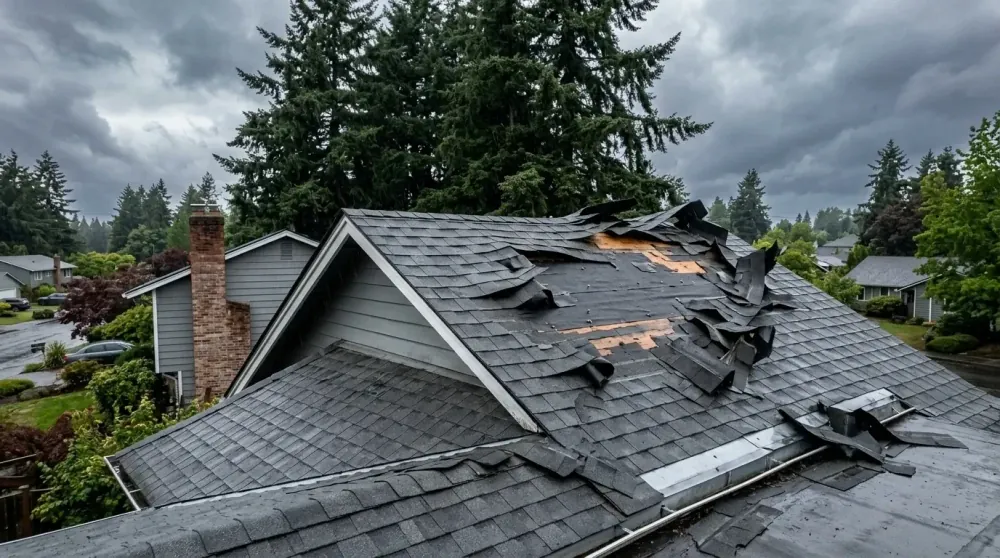
Gorge winds often bend shingle tabs back without tearing them off. The inner fiberglass cracks even if the shingle lays back down. Our storm checks spot hidden shingle creases and lifted edge metal.
After big winds, homeowners may look up and see no missing shingles. But wind often bends tabs and breaks inner seals. Hidden cracks can lead to leaks weeks later:
- Wind-Creased Shingles: When wind suction lifts a shingle tab upward and bends it backward, the internal fiberglass reinforcement mat breaks along a horizontal line just below the sealant strip. The shingle tab then drops back into place, looking flat from the ground, but its waterproof asphalt barrier is cracked and permanently compromised.
- Drip Edge & Gutter Apron Separation: Raking winds pull perimeter metal flashings away from fascia boards, breaking the waterproof seal and channeling rainwater directly behind gutters into exterior wall framing.
- Chimney Counter-Flashing Failure: High wind vibrations loosen masonry mortar joints holding step and counter-flashings around brick chimneys, creating active entry paths for winter downpours.
6. Why Do Saturated Soils Create Douglas Fir Fall Hazards for East Clark County Roofs?
Weeks of winter rain soak Clark County soil. Shallow tree roots get loose in wet clay. Big gusts snap heavy tree limbs that puncture roof decks.
Winter wind storms hit right after weeks of heavy rain. Tall fir trees lose root grip in soaked clay dirt:
A falling tree branch hits with huge force, cracking 2x6 rafters and wood decking. Our emergency crew works with crane teams and tree pros to clear limbs safely. We seal holes fast with storm tarps.
7. How Do You Protect Your Roof During Columbia Gorge Windstorms?
During severe winter windstorms, install architectural laminate shingles using an enhanced 6-nail fastening schedule rated for 130 MPH winds, and contact our emergency response crew at (360) 325-8254 for rapid 24/7 tarping response across Clark County.
Storm Advisory Protocol
During winter, Columbia Gorge wind speeds regularly exceed 70 MPH across Washougal, Camas, and East Vancouver. Roofs with substandard nail patterns or aging adhesives suffer severe tab lift, exposing underlayment to torrential rain.
- 6-Nail Fastening Pattern: Our certified roofing crews install reinforced architectural shingles engineered to withstand high-velocity gusts up to 130 MPH.
- Immediate 24/7 Response: If wind or falling tree limbs puncture your roof, contact our emergency crew at (360) 325-8254 for rapid emergency tarping deployed promptly.
8. Who Authored and Technically Verified This Storm Advisory?
This storm advisory was written by our Master Roofing Specialist, with 22 years of storm recovery operations in Southwest Washington, and verified by our Senior Estimator.
Emergency News Hotline
Columbia Gorge Storm Incident Response Team | Clark County, WA
Our Technical Lead has directed storm recovery operations for eight major Columbia Gorge windstorm declarations over 22 years in Southwest Washington.
9. Frequently Asked Questions About Columbia Gorge Wind Storms in Clark County?
Below are expert contractor answers regarding Gorge wind speeds, local building code wind ratings, emergency tarping response times, and roof safety protocols in Vancouver WA.